
AI Customer Service Agent vs Human Agent: Which Should Handle Your Support?
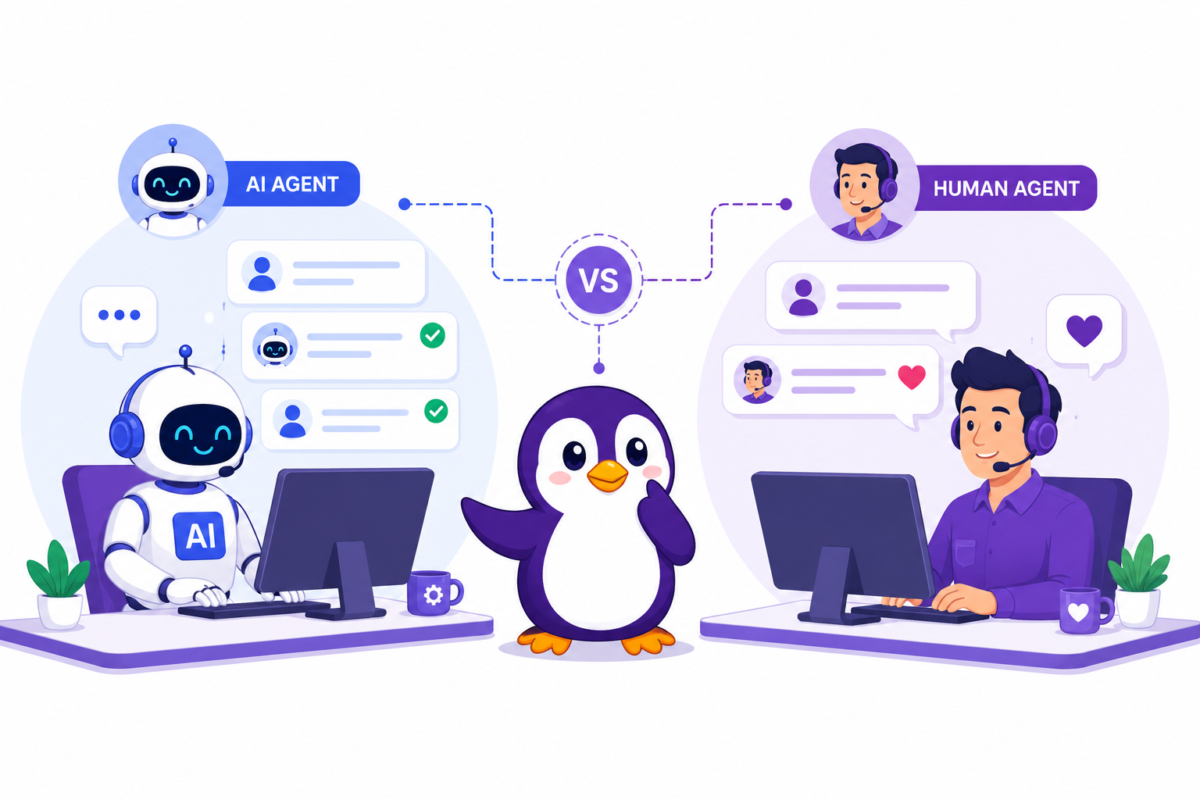
The spreadsheet answer to the AI customer service agent vs human agent question isn’t close. A human-handled support ticket costs somewhere between $6 and $13.50 once you count salary, benefits, training, and management overhead, according to benchmarks from Gartner and Forrester.
An AI-resolved ticket costs $0.50 to $2.00. On paper, that’s a 5-to-20x cost difference, and it’s the number every AI customer service vendor leads with.
But the spreadsheet doesn’t ask the question your customers actually care about: did the problem get solved, and did it feel like anyone was actually listening?
This “humans vs robots” framing gets thrown around a lot, but cost and experience don’t move together, and the honest answer depends entirely on which tickets you’re talking about, not a blanket policy for your whole support inbox.
The Short Answer
Neither wins outright, the real decision is which tickets go where, not choosing one system over the other. AI agents win decisively on cost and speed for high-volume, repetitive questions -order status, password resets, basic account changes.
Human agents win on anything emotionally sensitive, genuinely complex, or where a customer has already tried AI and is frustrated. Most support operations that actually work well in 2026 run both at once, with AI handling the first layer and a clear, fast handoff to a person when it can’t finish the job.
What Is an AI Customer Service Agent, and How Is It Different From a Human One?
An AI agent for customer service is software (an AI Chatbot) that independently understands, responds to, and resolves customer support conversations – often by pulling real data from connected systems like order or account records – without a human handling every interaction.
A human agent brings judgment, emotional read, and the ability to make an exception or bend a policy when the situation calls for it, none of which an AI agent can genuinely do on its own, regardless of how well it’s trained.
The practical difference isn’t intelligence, it’s scope. AI agents are built to handle high-volume, repetitive, well-documented questions instantly and around the clock. Human agents are built to handle everything outside that pattern -the account that got mistakenly closed, the customer who’s genuinely upset, the situation where the “correct” answer according to the policy document isn’t actually the right call.
If you search AI tools for customer service, you can browse them all Here : AI Customer Service Tools.
The Cost Case for AI Is Real, and Bigger Than Most People Expect
We checked multiple independent benchmarks rather than relying on a single vendor’s number, and the range is remarkably consistent across sources: Gartner puts the average human-assisted contact at $13.50, Forrester’s range is $8–$12, and SQM Group’s channel-specific data puts phone support at the high end, $17–$25 per contact. AI-resolved tickets, across the same set of sources, land between $0.50 and $2.00 depending on the vendor and pricing model.
The gap compounds in a way that doesn’t show up on the salary line either. Call-center attrition runs 40–45% annually industry-wide, with first-year attrition specifically closer to 65–70% -meaning a large share of the agents a company trains are gone within twelve months, and replacing one agent costs $10,000 to $20,000 in direct expense, or up to $46,000 once lost productivity during the ramp-up period is factored in. None of that cost exists on the AI side of the ledger.
A healthy dose of skepticism helps here, though: several of the most-cited cost comparisons come from AI vendors themselves (Fin, eesel, and similar), who have an obvious incentive to make the gap look as large as possible.
The direction of the data is consistent even in more neutral sources like Gartner and Forrester, but treat the most dramatic multiples -some vendor content claims 12x to 24x savings -as the upper end of a real range, not a guaranteed outcome for your specific ticket mix.
What Human Agents Provide That AI Agents Can’t?
Cost comparisons make AI look like the obvious winner, so it’s important to name specifically what gets lost when a human isn’t involved – the real robots vs humans divide isn’t about intelligence; it’s about what each one is actually capable of doing well.
Judgment on exceptions. A policy document can’t anticipate every situation, and a human agent can look at genuinely unusual circumstances and decide a rule shouldn’t apply this time. An AI agent either follows the documented policy exactly or escalates -it doesn’t independently decide a rule is wrong for this specific case.
Reading emotional context. A human agent can tell the difference between a customer who’s mildly annoyed and one who’s genuinely at a breaking point, and adjust tone, pacing, and even the offer on the table accordingly.
AI sentiment detection has improved, but it still responds to signals of emotion rather than actually understanding why a customer feels the way they do.
De-escalation through genuine acknowledgment. Part of what calms an angry customer down is feeling heard by another person, not receiving a well-formatted apology. A scripted-sounding “I understand your frustration” from an AI agent can register as hollow precisely because the customer knows nothing on the other end actually experienced the frustration.
Creative problem-solving outside the documented process. When a situation genuinely doesn’t fit any existing workflow, a human agent can improvise a solution. AI agents are fundamentally constrained by what they’ve been trained or configured to do -a genuinely novel problem is where they stop being useful and start guessing.
Accountability a customer can actually feel. When a human agent makes a promise -a callback, a follow-up, a specific resolution timeline -there’s a real person whose job performance is tied to keeping it. That accountability is part of why a human commitment often carries more weight with an upset customer than an identical AI-generated one.
3 Questions to Ask Before You Automate a Ticket Type
The framework above sorts individual tickets. Before deciding to automate an entire category of tickets, it helps to answer three questions about your own operation first.
1. If AI gets this wrong, how much does it actually cost? A wrong answer about store hours is a minor inconvenience. A wrong answer about a refund eligibility rule or a medical/financial detail can create a real liability. Automate low-stakes categories first, and be more cautious with anything that has real downside if the AI is confidently wrong.
2. Is the underlying knowledge base actually current? AI resolution quality is directly tied to how well-maintained the documentation behind it is -IBM’s own research found resolution rates can drop from around 80% down to 40–55% when the knowledge base is outdated or incomplete. Automating a ticket type on top of stale documentation just automates the wrong answer faster.
3. How easily can a frustrated customer actually reach a human? If the honest answer is “it takes several steps” or “there’s no obvious way,” that’s a sign you’re not ready to automate that category yet, regardless of how good the AI’s resolution rate looks in a vendor demo. The handoff path matters as much as the AI itself.
Advantages and Disadvantages of AI vs Human Agents
| Factor | AI Agent | Human Agent |
| Availability | 24/7/365, instant, unlimited concurrent conversations | Business hours, one conversation at a time |
| Consistency | Same answer every time, no bad-day variance | Can vary by agent mood, experience, or fatigue |
| Handling repetitive questions | Excellent – this is its core strength | Reliable but a poor use of a person’s time at scale |
| Handling emotional situations | Weak – can sound scripted or miss the emotional cue entirely | Strong -can genuinely de-escalate |
| Policy exceptions and judgment calls | Cannot make them independently | Can make a real-time call when the situation warrants it |
| Learning curve for new issue types | Needs to be retrained or reconfigured | Can improvise on a genuinely novel problem |
| Turnover/retention cost | None | 40–45% annual attrition industry-wide |
| Scalability during volume spikes | Instant, no hiring needed | Requires overstaffing or accepting slower response times |
AI vs Human Support: The 2-Question Ticket Routing Test
Rather than trying to categorize every possible ticket type individually, two questions sort almost any support conversation into the right lane.
Question 1 -Is the customer neutral or already charged? Are they calmly asking something, or already frustrated, upset, or angry when the conversation starts?
Question 2 -Is the answer documented, or does it require judgment? Is there a clear, written policy that covers this exactly, or does it need discretion, an exception, or a human decision call?
Putting those two questions together gives four practical outcomes:
| Factors | Answer Is Documented | Answer Requires Judgment |
| Customer Is Neutral | AI handles it fully -order status, password resets | AI can draft a response, but a human should approve it before it goes out |
| Customer Is Charged | Route to a human, even though the answer itself is simple | Always a human -this is where the stakes are highest |
A concrete example makes the difference obvious: “Where’s my order?” is neutral and documented, so AI handles it end to end. “I’ve emailed three times about my late order, and no one has responded. I want a refund now” is asking essentially the same underlying question, but the emotional weight moves it straight to a person, regardless of how simple the actual policy answer is.
Conclusion
This was never really a humans vs robots fight to begin with – AI and human agents are built for different jobs, not competing for the same one. Use the cost data to justify automating the repetitive, well-documented share of your tickets, and use the 2-Question Test above to keep anything emotionally charged or judgment-heavy with a person.
The businesses that get this wrong usually aren’t using AI badly -they’re using it on the wrong tickets, or hiding the path back to a human when it fails.
Frequently Asked Questions
Is AI customer service actually cheaper than human agents?
Yes, substantially, for the tickets it can genuinely resolve. Independent benchmarks from Gartner and Forrester put human-handled tickets at $6–$13.50 each, versus $0.50–$2.00 for AI-resolved ones. The catch is that AI doesn’t resolve everything -realistic deflection rates for a well-run deployment sit around 30–55%, so the savings apply to a share of your volume, not all of it.
Do customers actually prefer talking to a human?
It depends heavily on the type of issue. Research cited by Forrester found 68% of customers are comfortable with AI handling simple, repetitive questions, while 75% prefer a human specifically for complex or emotionally sensitive issues.
Most customers aren’t anti-AI in general -they want the right tool for the specific problem they have.
Can a business fully replace human customer service agents with AI?
No, not realistically.
AI is excellent at handling high-volume, repetitive, and well-documented questions. But it still struggles with emotional situations, judgment calls, exceptions, and anything that feels messy or personal to the customer. Even the best AI tools leave a significant portion of conversations that need a human.
Most companies that try to go fully AI end up with frustrated customers, higher complaint rates, and eventually have to bring people back. The smarter approach is using AI for the easy, repetitive work while keeping humans available for everything that needs real judgment or empathy.
What kinds of support tickets should never go to AI?
Billing disputes, formal complaints, anything requiring a policy exception, and interactions with a customer who’s already frustrated are the clearest cases.
These are exactly the situations where the 75% human-preference number applies, and where a technically “resolved” AI ticket that doesn’t actually address the customer’s frustration can do more damage than a slower human response would.
How do most businesses actually combine AI and human support in 2026?
Most businesses use a layered approach instead of choosing one or the other. AI takes the first response and resolves the repetitive, well-documented tickets it can handle.
When it can’t finish the job, it quickly hands the conversation to a human.The businesses that get poor results are typically the ones with a slow, hidden, or difficult-to-reach human escalation path, not the ones using AI itself.
Looking for tools that make this layered approach easy? Start with our comparison of the 7 best AI customer service tools
Comments