
AI Menu Generator vs Hiring a Designer: Which One Is Actually Better?
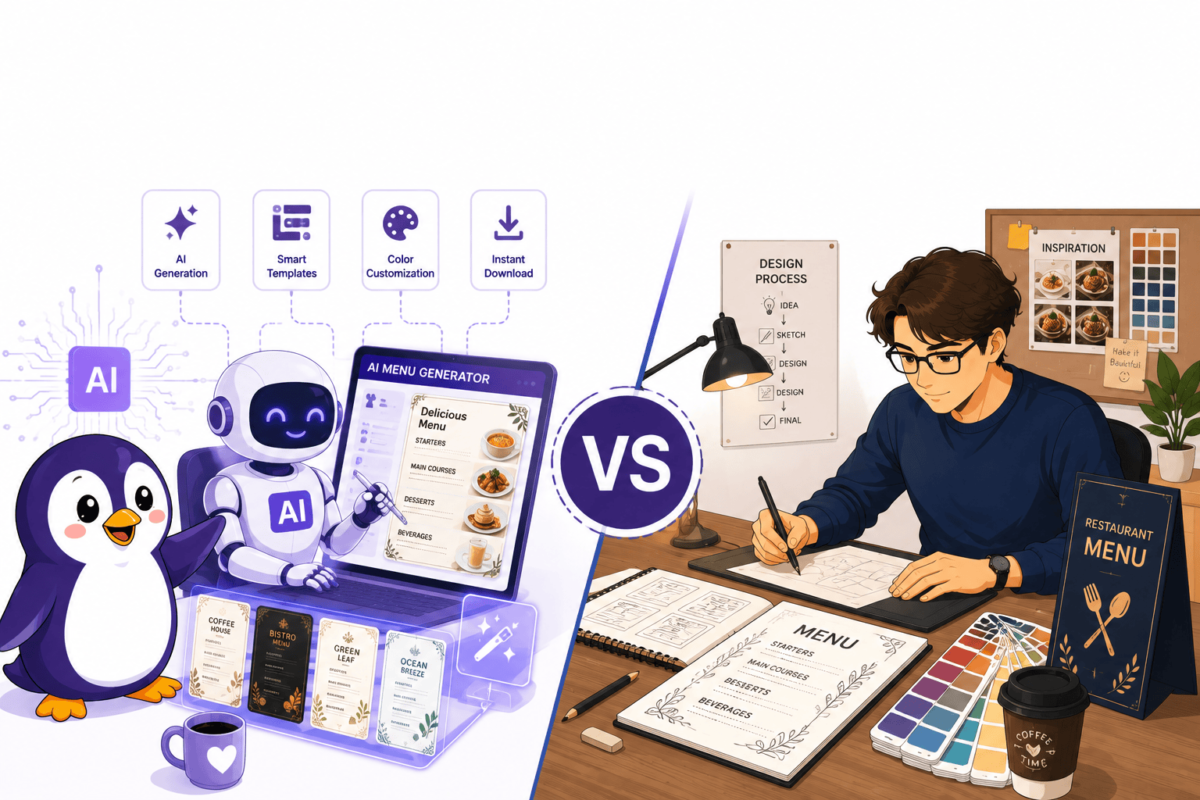
You’ve narrowed it down to two options, and they genuinely don’t feel like they’re on the same scale. One costs nothing to start and gives you a finished menu in about five minutes. The other means writing a brief, waiting days, going back and forth on revisions, and paying somewhere between $200 and $2,000 depending on who you find. It’s tempting to assume the free, five-minute option must be the obvious answer, until you actually think about what a menu is doing for your business beyond just looking nice.
So in the actual debate of AI menu generator vs hiring a designer, which one is really better? The honest answer is that it depends on what your menu needs to do for you, and that answer is different for a five-table café than it is for a 60-cover fine-dining room. Here’s the real comparison, with actual numbers on both sides, not just a vague “it depends.”
The Short Answer
For most independent restaurants, especially new ones or places updating their menu often, an AI generator wins on cost and speed, and the gap in quality is smaller than most people assume. Hiring a designer earns its price back mainly in one specific situation: when the menu is doing serious strategic work for a higher-end or established brand, where the psychology of layout and pricing genuinely moves the needle on revenue. If your menu just needs to look clean and be easy to update, that extra strategy layer usually isn’t worth the extra wait or the extra cost.
What You’re Actually Paying For, Not Just What It Costs
The Designer Side
A freelance graphic designer typically charges $25 to $150 an hour, and a full menu project, writing this out plainly because most “how much does menu design cost” pages bury it, usually lands between $200 and $1,500 for a single or double-page menu, climbing toward $2,000+ for something more complex, multi-page, or agency-produced.
A typical project takes 10 to 30 hours of actual design work, and turnaround runs 3 to 14 days for a freelancer, 1 to 3 days for a design studio, or 1 to 2 weeks for a full agency handling strategy and photography together.
None of that includes printing, which runs separately at anywhere from a few cents to a few dollars per copy depending on paper stock and volume, or food photography, which typically adds another $150–$500.
This is the part that actually explains the price gap, so it’s worth being specific: a designer’s fee isn’t buying a nicer font; it’s buying the deliberate application of menu psychology, decisions about pricing format and layout that a generic AI prompt won’t make on its own unless you specifically know to ask for them.
A real example, worth knowing regardless of which option you pick: a 2009 Cornell University School of Hotel Administration study, run with the Culinary Institute of America, tested three menu price formats on real diners, “$14.00,” “14,” and “fourteen dollars”, and found the numeral-only version, with no dollar sign or the word “dollars,” led to noticeably higher spending, which the researchers linked to a “pain of paying” response triggered by seeing a currency symbol. (Worth noting: the researchers themselves flagged that the exact percentage difference wasn’t the direct subject of their statistical testing, so treat it as a real, directionally solid finding rather than an exact number to bank on.)
Descriptive language, “cedar-planked,” “slow-roasted,” “freshly caught” instead of just the dish name, is also commonly cited in menu-engineering guides as boosting a specific item’s sales, sometimes by as much as 27%, though exact figures vary by source and restaurant.
None of that is decoration. It’s a designer (or a menu-engineering consultant) deliberately steering attention toward your highest-margin dishes, a discipline formally named “menu engineering” back in 1982 by Michigan State University hospitality professors Michael Kasavana and Donald Smith, and it’s the specific expertise a generic AI prompt doesn’t apply on its own.
The AI Side
An AI menu generator, by contrast, typically costs nothing to start and produces a complete layout in under five minutes from a text description of your dishes and prices. Even the paid tiers across this category mostly sit under $10–15 a month, and updating a price or swapping a seasonal item is a re-prompt or a quick edit rather than a new invoice. For a restaurant that changes its menu often- specials boards, seasonal swaps, price adjustments as ingredient costs shift- that update speed alone can be worth more in practice than the upfront design quality gap.
What you’re not getting: any of the psychology above. An AI tool will lay out your dishes in clean, readable sections, but it has no idea which of your dishes actually carries the highest margin, and it won’t deliberately box your best-selling entrée or write a description engineered to move a specific slow seller. It generates a menu; it doesn’t engineer one.
The Real Risk Nobody Mentions: AI Gets Facts Wrong, and That’s a Legal Problem
This is worth taking seriously rather than treating as a minor inconvenience. When Square rolled out its own AI menu generator, built on models including GPT-3.5 and GPT-4, a TechCrunch report flagged a real concern alongside the convenience: generative AI’s known tendency to produce inaccurate output becomes a genuine liability risk on a menu specifically, since a wrong ingredient, an incorrect allergen claim, or a made-up description could expose a restaurant to false-advertising complaints, not just an embarrassing typo. Square’s own response was to keep a human review step mandatory; AI output is offered as an editable suggestion, not something that publishes automatically.
That’s the practical takeaway regardless of which option you choose: whatever a tool generates, a human- you, a manager, or the designer you hired- needs to actually read every dish description and price before it goes live. A designer building the menu by hand is less likely to invent a fictional ingredient than an AI model is, but neither option should skip a final human proofread.
Where a Designer Still Wins Outright
A specific situation makes the higher cost and slower timeline genuinely worth it:
- A flagship menu for a higher-end or fine-dining concept, where the menu itself is part of the physical brand experience, paper stock, print finish, typography choices that need a trained eye, not just a template.
- A one-time investment meant to last years, not something you’ll be re-editing every season, which changes the math: $500–1,500 spent once and left alone for two or three years is a very different calculation than the same spend redone every quarter.
- A full brand overhaul, where the menu needs to work as one piece of a larger identity system (logo, signage, packaging) that a general AI tool has no visibility into and can’t stay consistent with on its own.
Where an AI Generator Genuinely Wins
- A new restaurant or café testing its concept, where the menu itself will likely change within months as you learn what actually sells.
- Anywhere prices or specials change often, the update speed difference (a re-prompt vs. a new design invoice) compounds fast over a year.
- A tight or nonexistent design budget, especially for a solo operator who needs something professional-looking today, not in two weeks.
If any of these sound like your situation, our full roundup of AI menu generators is a good place to start comparing options.
The Middle Ground Most People Miss
These two options aren’t strictly either-or. A genuinely practical approach for a lot of independent restaurants: generate a first draft with an AI tool to nail down structure, sections, and a rough look for next to nothing, then pay a freelancer a smaller, focused fee not a full from-scratch project to review it specifically for menu-engineering placement (which items get visual emphasis, where your highest-margin dishes sit) and to proofread every price and description for accuracy. That gets you most of the strategic value a full designer engagement provides, at a fraction of the cost and turnaround time, without pretending an AI tool already knows your food-cost percentages.
Conclusion
If you’re starting out, updating your menu often, or working with a tight budget, an AI menu generator is the smarter choice; it’s fast, nearly free, and easy to change. Hire a designer only when your menu genuinely needs to carry strategic weight: a fine-dining flagship, a full brand overhaul, or a one-time investment meant to last years. For most independent restaurants, the best answer isn’t picking one side forever; it’s starting with AI, and bringing in a designer’s expertise only when the stakes actually justify the cost.
Frequently Asked Questions
Is an AI menu generator actually good enough to replace a designer?
For most independent restaurants, an AI generator can genuinely handle the day-to-day job of creating a clean, professional-looking menu that’s easy to update. But “replace” isn’t quite the right way to think about it: no AI tool fully replaces human judgment; it just shifts where that judgment gets applied. The gap that stays open is the strategic layer: deliberate pricing psychology, item placement, and margin-aware layout, which either needs a designer or menu-engineering consultant applying it on purpose, or you learning enough about it to apply it yourself on top of whatever the AI generates.
How much does it cost to hire a designer for a restaurant menu?
Typically $200 to $1,500 for a standard single or double-page menu, based on an hourly rate of $25–$150 and roughly 10–30 hours of work, with more complex or agency-produced menus running $2,000 or more. That figure doesn’t include printing or food photography, which are usually billed separately.
Can a good menu design actually increase sales, or is that overstated?
It’s genuinely backed by research, not just marketing claims, though some of the specific numbers floating around deserve a closer look than they usually get. A real 2009 Cornell University/Culinary Institute of America study found that removing currency symbols from menu prices led to noticeably higher spending, though the researchers themselves noted the exact percentage wasn’t the direct subject of their statistical testing, so treat it as a real, solid directional finding rather than a precise guarantee. Descriptive language lifting a specific dish’s sales (commonly cited around 27%) shows up consistently across menu-engineering resources too. The underlying effect is real; the question is whether your restaurant needs that level of engineering or just a clean, professional layout.
What’s the biggest risk of using AI to generate a menu?
Factual accuracy. AI-generated text can occasionally invent or misstate an ingredient, allergen, or description, which is more than a typo risk on a document customers rely on to make food-safety and purchasing decisions. Every AI-generated menu should get a full human read-through before it’s printed or published, regardless of which tool produced it.
Should I use an AI menu generator and a designer together?
It’s a genuinely underused option. Generate a structural first draft with an AI tool for free or nearly free, then pay a freelancer a smaller, targeted fee to review item placement and pricing psychology and proofread the final content rather than paying for a full project built entirely from scratch.
Comments